Chapter 5.0

Planting plan & patterns

The one graphic device, a plan of beds seen from above, and the five patterns it is planted with.

  1. 5.1What it is
  2. 5.2Construction
  3. 5.3Group variations
  4. 5.4Where it is used
  5. 5.5Do and don’t
  6. 5.6The five patterns
  7. 5.7Using a pattern
  8. 5.8Hardscape patterns

5.1 · What the planting plan is

The wordmark, planted.

The planting plan is a landscape plan seen from above. It is the only graphic device WILS has.

It has four beds. They are as wide as the letters W, I, L and S, so the plan is the footprint of the word. It is not a symbol.

Each plant group plants its beds in its own way. The plant’s ID decides which cells are planted, so every plant gets its own plan.

Rule

The plan is a pattern, not a logo. It never sits beside the wordmark as an icon.

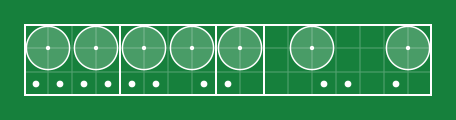
A strip of planting plans repeating the beds 7, 2, 4 and 4, filled with the five group colours.

A mixed plan. Each bed takes one group colour, with white paths between the beds.

A taller mixed planting plan with six rows of cells.

The same plan at six rows, as used on a cover.

5.2 · Construction

17 columns. Four beds.

One unit is the width of a W divided by seven. A plan is 17 units wide: beds of 7, 2, 4 and 4. Do not change these widths. They tie the plan to the wordmark.

A cell is 8 px times a whole number. Rows are 2 on mobile, 3 on pages and 6 on covers. Cells that are not planted stay as open ground, a hairline square.

Lines and opacities
PartValue
Cell8 px × n
Columns17: beds 7 · 2 · 4 · 4
Rows2 mobile · 3 page · 6 cover
Open ground1 px hairline, 28% opacity
Bed edge, frame2 px
Path between beds3 px, Paper
Tree canopy fill22% opacity
W I L S 7 2 4 4

The four letters set the bed widths: 7, 2, 4 and 4 units. The dashed lines are the letter edges.
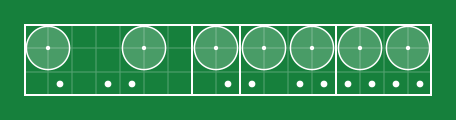
Trees planting plan, first seed.
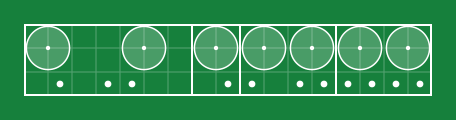
Trees planting plan, second seed.
Trees planting plan, third seed.

Same group, three plants. Only the seed changes. The same ID always draws the same plan.
5.3 · Group variations

Each group plants by its own rule.

On a plant page the plan uses that plant’s group and sits on that group’s colour. Symbols and edges are Paper on Trees, Shrubs, Groundcovers and Climbers. They are Ink on Palms.

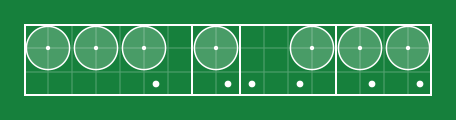
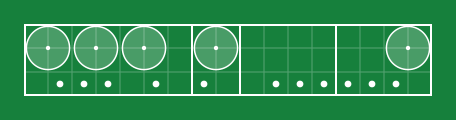
Trees plan: round canopies with a centre dot, on the Trees green.
Trees

Canopy circles with a centre stem, small dots between.
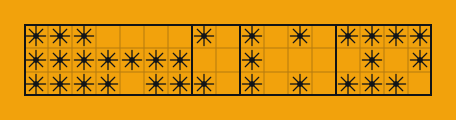
Palms plan: single crowns with eight fronds, on the Palms amber.
Palms

One crown of eight fronds per cell.

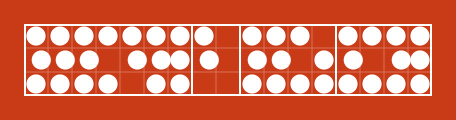
Shrubs plan: staggered solid dots, on the Shrubs red.
Shrubs

Solid dots in staggered rows.

Groundcovers plan: solid squares, on the Groundcovers blue.
Groundcovers

Solid squares that fill the cell.

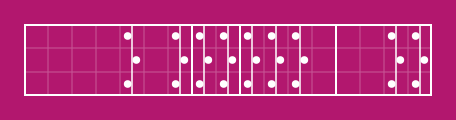
Climbers plan: wire lines with alternating leaves, on the Climbers magenta.
Climbers

A wire line with a leaf on alternate sides.

Planting rules
GroupDrawingChance a slot is planted
Trees2 × 2 canopy, centre stem. Circle radius 0.9 unit, 22% fill, 1.5 px line. Small dots in the last row.78% canopy · 50% dots
PalmsOne crown, 8 spokes of 0.4 unit, 1.3 px, round caps, centre dot.62%
ShrubsSolid circle radius 0.4 unit. Odd rows offset 0.22 unit, kept inside the bed.80%
GroundcoversSolid square, inset 10% in its cell.60%
ClimbersFull-height 1.5 px wire, a leaf dot per row, alternating sides.55% per column

5.4 · Where it is used

Rarely, and never behind text.

The website is plain, so the plan is used sparingly. It appears on covers, on share cards and in print, and as a quiet strip where a page needs one.

A plan sits inside its colour field with space around it. It never touches the page edge. It never sits behind text or data.

On Arabic pages the plan is mirrored. On a card the group is a dot, not a plan.

Covers
Mixed plan, 3 × WILS, 6 rows
Home strip, share card
Mixed plan, 3 × WILS, 2 rows
Plant page
Group plan, 3 rows (2 on mobile)
Print
Same plans, vector
Trees planting plan on a full Trees field.

On a plant page: the page group colour, the group plan, framed and inset.

Trees planting plan at two rows, for mobile.

Mobile, 2 rows.

The same Trees planting plan, mirrored for Arabic.

Arabic, mirrored.

5.5 · Do and don’t

Keep it a plan.

Keep the 7 · 2 · 4 · 4 widths. Keep the group colours. Keep the lines at 1, 2 and 3 px.

Do not add gradients, shadows or rounded corners.

Palms plan on its own field with an inset frame.
Do

Draw the plan inside its field, framed, with space around it.

Trees plan mirrored for Arabic.
Do

Mirror the plan on Arabic pages.

WILS
Don’t

Put the plan beside the wordmark as an icon.

Albizia lebbeck
Don’t

Put text or data on top of the plan.

Don’t

Recolour a group.

Albizia lebbeck
Do

On a card, show the group as a dot. Never draw a plan at card size.

5.6 · The five patterns

Every slot planted.

Each group’s planting rule, with every slot planted and no seed, is that group’s pattern. The five patterns are the plan without its beds: a field of one colour, the group’s own, with the symbol repeated on the unit grid in the on-colour. They are the only patterns WILS has, and they are the same drawing as chapter 5.3, so a pattern and a plan always match.

A pattern tiles without a visible seam. Trees repeat every two units, Groundcovers every two, Shrubs and Climbers every two rows, Palms every unit.

Rule

A pattern is one group colour and its on-colour. Never two groups in one pattern, never a tint, never Ink symbols on Paper.

TreesCanopy circles, 2 × 2 units, centre stem
PalmsOne crown of eight fronds per unit
ShrubsSolid circles, rows offset 0.22 unit
GroundcoversSolid squares, every other unit
ClimbersA wire per column, a leaf per row, alternating sides

The five patterns at one unit = 24 px. The hairline grid is part of the pattern, as in the plan.

5.7 · Using a pattern

A background for things that are not text.

A pattern fills a surface where a plain field would do, and says which group it belongs to: the back of a document, the cover of a group report, the far side of a share card, a wall, a bag, a sign. It is a ground, not a picture. Text never sits on it. Put text in a Paper block on top, or beside the pattern on a plain field.

Scale
WhereOne unit
Screen, small16 px
Screen, covers and cards24 to 40 px
A4 and A3 print6 to 10 mm
Signs, walls, fabric40 to 120 mm

Choose a unit so at least four repeats fit across the surface. Scale in whole multiples of 8 px on screen. Start the tile at the top start corner; the pattern may run off every edge, since it is a ground.

Rule

One pattern per surface. Never behind text, never behind a drawing, never next to the wordmark as if it were part of the logo. On the website the plan is used, not the pattern.

Trees of the GulfWILS · Group report · 2026
A report cover: Trees pattern, title in a Paper block.
WILS
Nerium oleanderOleander · Shrub
A share card back: Shrubs pattern on the start side, the wordmark and the name on a Paper panel. The wordmark never sits on the pattern.
One unit = 16 px
24 px
40 px

Two uses, and the Palms pattern at three scales. Lines stay 1.3 to 1.5 px on screen whatever the unit.

5.8 · Hardscape patterns

Four more, proposed.

Hardscape has no planting plan, so the four hardscape groups get a pattern each, drawn with the same pen on the same unit grid and in the same way: one colour, the on-colour, no grid lines. Each is the plainest mark for its areas. They are proposed until the owner approves them, and they appear nowhere on the website yet.

Rule

Ink on Sandstone, Paper on Granite, Cobalt and Corten. The same scale and use rules as the plant patterns.

SurfacesRunning bond, two units long, one high
Edges & wallsA kerb step, one unit up, one along
Water & soilGrate slots, two per unit
Furniture & lightA post with a lamp, a bench every other unit

Surfaces, Edges & walls, Water & soil, Furniture & light. Proposed, owner review.